
Science / Agriculture
The
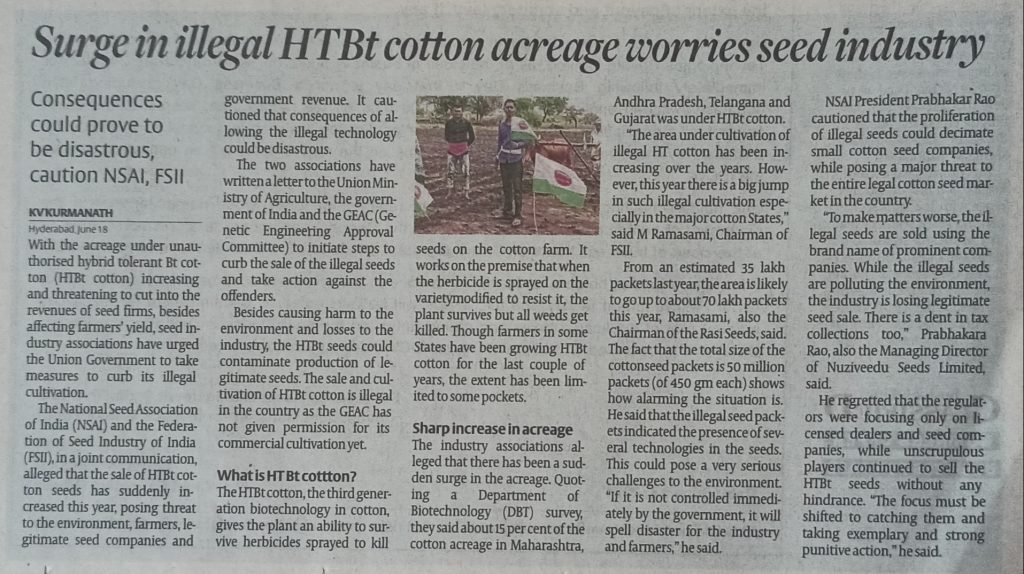
unlawful cultivation of herbicide tolerant (HT) Bt cotton has seen a large jump
this year, with seed makers claiming that the sale of unlawful seed packets has
over doubled from thirty lakh last year to seventy five lakh this year.
·
Bt cotton remains the sole
GM crop allowed to be cultivated within the country.
·
It was developed by United
States giant Bayer-Monsanto.
·
It involves insertion of 2
genes viz ‘Cry1Ab’ and ‘Cry2Bc’ from the soil bacteria bacillus thuringiensis
into cotton seeds.
·
This modification codes the
plant to provide protein toxic to heliothis bollworm (pink bollworm) therefore
creating it resistant to their attack.
·
The industrial release of
this hybrid was sanctioned by the govt. in 2002.
About
HT Bt Cotton
·
The farmers planted an
herbicide-tolerant kind of Bt cotton.
·
This variety (HtBt)
involves the addition of another gene, ‘Cp4-Epsps’ from another soil bacteria,
agrobacterium tumefaciens.
·
It isnt cleared by GEAC.
·
The farmers claim that the
HtBt variety will withstand the spray of glyphosate, an herbicide thats wont
to take away weeds, and therefore it well saves them deweeding prices.
What
is the procedure involved?
·
In India, its the
responsibility of the genetic engineering Appraisal Committee(GEAC) under the
atmosphere Ministry to assess the security of a genetically changed plant, and
decide whether its fit for cultivation.
·
The GEAC comprises
specialists and government representatives, and a choice it takes needs to be
approved by the atmosphere Minister before any crop is allowed for cultivation.
·
Besides Bt cotton, the GEAC
has cleared 2 alternative genetically changed crops,brinjal and mustard.
·
But these havent received
the consent of the atmosphere Minister.
·
Legally, sale, storage,
transportation and usage of unapproved GM seeds may be a punishable offence
below the principles of Environmental Protection Act 1986.
·
Also, sale of unapproved
seeds will attract action under the Seed Act of 1966 and therefore the Cotton
Act of 1957.
·
The Environmental
Protection Act provides for a jail term of 5 years and a fine of Rs one lakh
for violation of its provisions, and cases will be filed under the other 2
Acts.
·
The culprit may be charged
under varied sections of the Essential
·
Commodities Act and
therefore the Indian penal code.
Comments