
International Relations
India’s
move to release 5 million barrels of oil from its strategic reserves as part of
a coordinated challenge led by the US against the OPEC+ producers’ cartel’s
move to curb output.
Background:
·
It is part of a concerted effort ( USA,
China, EU , Britain , Republic of India )to negate upward pressure on crude
costs from OPEC+ — a 13-country grouping of oil exporters that has been joined
since 2016 by ten others led by Russia to make a decision production quotas —
keeping provide below demand, even though the action is largely symbolic in
nature.
·
India has called for an increase in the
provide by OPEC+ at multiple international forums and in bilateral talks with
oil manufacturing countries. India argues that top crude oil costs are
impacting the post-Covid economic recovery, particularly within the developing
countries.
·
It is that the
1st time that New Delhi would be dipping into its reserves to leverage it as a
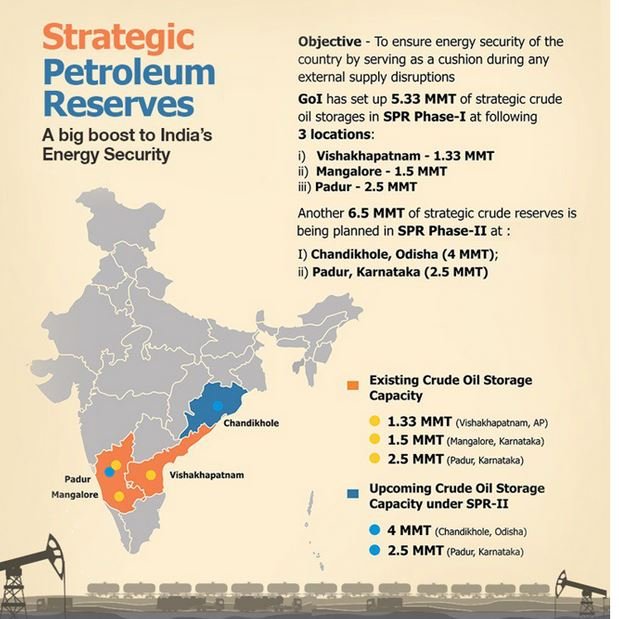
geopolitical tool India’s strategic reserves are the effort of a broader decide
to build an emergency stockpile with millions of barrels of petroleum, on the
lines of the reserves that the U.S. and its Western allies set up after the
first oil crisis of 1973-74.
·
These is
utilized in situation that include any natural tragedy or unforeseen world
event resulting in an abnormal increase in costs.
·
More about Strategic reserves: DPN Oct
9.
·
UN LDCs
standing The United Nations General Assembly has adopted a historic resolution
to graduate 3 nations, together with Bangladesh and Nepal, from the least
developed country (LDC) class to the developing country grouping, a major}
milestone demonstrating the countries’ significant development progress.
·
The U.N.
General Assembly (UNGA) adopted the resolution at its 76th session.
·
The 3
countries that got clearance for graduation are Bangla Desh, Nepal and also the
Lao People’s Democratic Republic.
·
The 3
countries can graduate from the LDC class after an exceptionally extended
preceding amount of 5 years (the standard period is of 3 years) to modify them
to arrange for graduation whereas designing for a post-COVID-19 recovery and
implementing policies and techniques to reverse the economic and social damage
incurred by the COVID-19 shock, Bangladesh is currently scheduled to formally become a developing country in
2026 because the U.N. committee suggested that the country should get 5 years,
to organize for the transition .
·
All the three eligibility criteria for
graduation involving per capita income, human assets index (HAI), and economic
and environmental vulnerability index (EVISince 1971, the United Nations has
recognized least developed countries
(LDCs) as a class of States that are deemed extremely disadvantaged in their
development method, for structural, historical and additionally geographical
reasons.
·
LDCs face more
than other countries the danger of deeper poverty and remaining during a
situation of underdevelopment.
·
More than 75 per cent of the LDCs’
population still live in poverty.
·
These countries are also characterized
by their vulnerability to external economic shocks, natural and man-made
disasters and communicable diseases.
·
As such, the
LDCs are in want of the highest degree of attention from the international
community.
·
Currently, the 46 LDCs comprise around
880 million people, 12 percent of the world population, which face severe
structural impediments to growth. However, the LDCs account for less than 2
percent of world GDP and around 1 percent of world trade.
·
Four United Nations Conferences on the
LDCs were held in: 1981, 1990, 2001 and 2011.
·
The Fourth
United Nations Conference on the least Developed Countries adopted the
Programme of Action for the least Developed Countries for the last decade
2011-2020 – the so-called Istanbul Programme of Action (IPoA).
·
LDCs are those
who suffer from severe structural impediments to achieve sustainable
development. Currently, there are forty six countries on the LDC list,
according to the U.N. Committee for Development Policy (CDP).
·
According to
the U.N., per capita financial gain of $1,230 is one amongst the requirements
for transitioning into a developing nation. Membership is revised each 3 years
supported
1. Per
Capita Income (GDP plus net income received from overseas)
2. Human
assets (level of population undernourished, under-five mortality rate, gross
secondary enrolment ratio and adult literacy rate)
3. Economic
vulnerability (such as population, remoteness, merchandise export
concentration, natural disasters, instability of agriculture production, and
instability of goods and services exports, among other factors). By
periodically identifying LDCs and highlight their structural issues, the United
Nations provides a strong signal to the international community to the
requirement of special concessions in support of LDCs. Concessions associated
with LDC standing include advantages within the areas of: Development
financing, notably grants and loans from donors and monetary establishments.
multilateral trading system, like
preferential market access and special treatments.
·
Technical assistance, notably, toward
trade mainstreaming (Enhanced Integrated Framework)
·
In past, six countries have graduated
from LDC status: Botswana in 1994, Cape Verde in 2007, Maldives in 2011, Samoa
in 2014, Equatorial Guinea in 2017, and Vanuatu in 2020.
·
UNCTAD extends to all graduating
countries a range of services aimed at supporting their progress toward
graduation from LDC status.
·
These include preparing vulnerability
profiles of states with the challenges of graduation, supporting them in their
preparation for a sleek transition to post-LDC life.
·
UNCTAD conjointly assists ex-LDC in
their quest for continuing socio-economic progress, notably, toward enhanced
economic specialization
Comments