
Polity
Lone BJP member left in Mizoram’s
tribal Chakma Autonomous District Council.
·
The Sixth Schedule of
the Constitution of India allows for the formation of autonomous administrative
divisions which have been given autonomy within their respective states.
·
Most of these
autonomous district councils are located in North East India but two are in
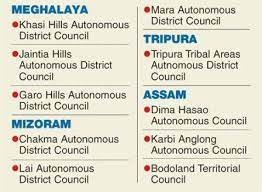
Ladakh, a region administered by India as a union territory. Presently, 10
Autonomous Councils in Assam, Meghalaya,
·
Mizoram and Tripura are
fashioned by means of distinctive feature of the Sixth Schedule with the
relaxation being formed because of other regulation.
·
The governor is
empowered to organise and re-organise the autonomous districts.
·
Thus, he can increase
or decrease their areas or change theirnames or define their boundaries and so
on.
·
If there are distinct
tribes in an self reliant district, the governor can divide the district into
numerous self sustaining regions.
·
Each self-reliant
district has a district council which includes 30 individuals, of whom four are
nominated by using the governor and the last 26 are elected on the idea of adult
franchise.
·
The elected members
hold office for a term of five years (unless the council is dissolved earlier)
and nominated members hold office during the pleasure of the governor.
·
Each autonomous region
also has a separate regional council.
·
The district and
regional councils administer the areas under their jurisdiction.
·
They could make laws on
certain designated topics like land, forests, canal water, shifting
cultivation, village administration, inheritance of assets, marriage and
divorce, social customs and so forth.
·
But all such laws
require the assent of the governnor.
·
The district and
regional councils inside their territorial jurisdictions can represent village
councils or courts for trial of fits and instances between the tribes
·
They hear appeals from
them.
·
The jurisdiction of
excessive court over those fits and cases is particular via the governor.
·
The district council
can establish, construct or manage primary schools, dispensaries, markets,
ferries, fisheries, roads and so on in the district.
·
It can also make
policies for the manage of money lending and buying and selling bynon-tribals.
·
But such regulations
require the assent of the governor.
·
The district and
regional councils are empowered to assess and collect land revenue and to
impose certain specified taxes.
·
The acts of Parliament
or the state legislature do not observe to self sufficient districts and
self-sustaining regions or apply with specified changes and exceptions.
Comments